Does Lenardo Da Vinci Was Making Political Statement in His Art?
Leonardo da Vinci is generally recognised as one of the great figures of the Renaissance and 1 of the greatest ever polymaths. As the world marks the 500th anniversary of his death, it'southward important to look at some of the ways in which he showed that – as well as being a painter, sculptor and engineer – he was a thinker who was way alee of his time.
Engineering – Dr Hywel Jones
Leonardo da Vinci is renowned every bit much for his inventions as his works of fine art, studies of architecture and anatomical drawings. The documents that survive show us his ideas for a wide range of devices. They include some of the first concepts for gliders, helicopters, parachutes, diving suits, cranes, gearboxes and many types of weapons of war. Many of these may be seen in utilise today, having taken the best part of 400 years to become practical realities.
He combined an imagination alee of his fourth dimension, an understanding of the emerging principles of science and engineering, and his meridian draftsmanship to devise new uses for levers, gears, pulleys, bearings and springs. His creations were designed to be useful but also to be highly-seasoned to his patrons: the warring dukes and kings of late 15th- and early 16th-century France and Italy.
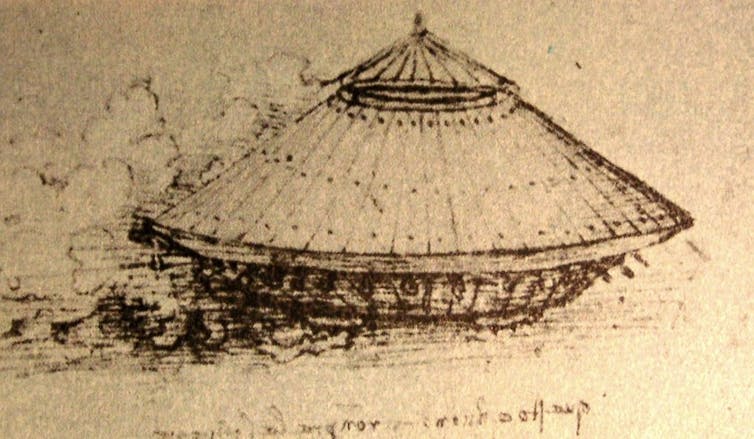
Although he apparently despised war, he was employed for much of the time as a military machine engineer, devising new defences and concepts for terrifying weapons. His sketches show a epitome "tank" circa 1485, with armour plating and the ability to fire in any direction.
We at present know that Leonardo'southward "tank", as fatigued, was not practical – information technology had mistakes in its gearing and would have been and so heavy that information technology could not have manoeuvred. Other weapons, designed to impress and intimidate as much as actually work, included the giant (27-metre) cross-bow, a gun with 33 barrels, ammunition which resembles today's "cluster bombs", and the first case of aerodynamically stabilised artillery shells.
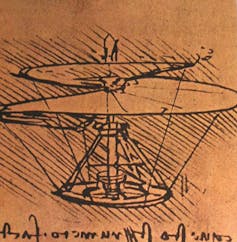
His sketches for an "aerial screw" (1486-90) anticipate the thought of the helicopter, although it was not the first sit-in of vertical flight – a Chinese toy with rotors predates this by 1,800 years.
Ornithopters, human powered flying machines which mimicked bird flight, were a fascination for him – and he drew many beautiful and innovative designs. However, bird flying was not fully understood at this time and he was unaware that a human beingness could never generate the required power to operate such devices.
Near of Leonardo'south designs were never congenital or tested, although modernistic-twenty-four hour period attempts to recreate them have met with mixed success, including some spectacular failures. His imagination was and so far alee of its time that it would accept 4 centuries before ideas such every bit the tank became practical through the development of light and strong materials, such every bit steel and aluminium, and new sources of power in the form of engines powered by fossil fuels. He would no doubt recognise – and be fascinated by – much of the mechanism of modern life that nosotros take for granted.
Mathematics – Dr Jeff Waldock
Although da Vinci is best known for his artistic works, he considered himself more than of a scientist than an artist. Mathematics – in particular, perspective, symmetry, proportions and geometry – had a significant influence over his drawings and paintings, and he was most certainly ahead of his time in making use of it.
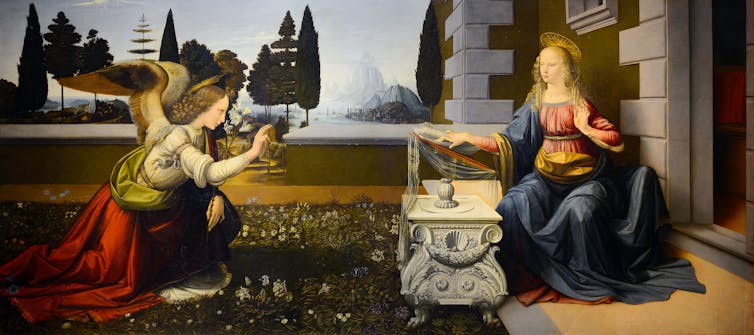
Da Vinci used the mathematical principles of linear perspective – parallel lines, the horizon line, and a vanishing point – to create the illusion of depth on a flat surface. In The Annunciation, for example, he uses perspective to emphasise the corner of a building, a walled garden and a path.
Leonardo's Last Supper is a prime example of the use of the mathematics of perspective. The architecture of the building around Jesus and the 12 apostles, also as lines on the floor below the table, create a "vanishing signal", providing a subconscious focal indicate for the painting.
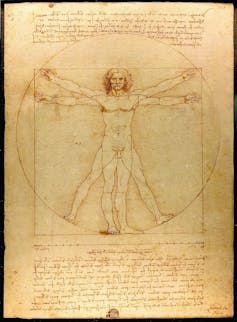
Leonardo knew of Vitruvius'southward work – that with the navel as the center, a perfect circle could be drawn around a body with outstretched arms and legs. He realised that if arm span and pinnacle are related, the person would fit perfectly within a square. His Vitruvian Human took these observations and attempted to solve the problem of "squaring" a circle. It's not, in fact, possible to do this exactly (squaring the circle is a metaphor for the impossible), but he managed to come very close.
There exists in mathematics a number, called the "Gold Ratio", which appears in some patterns in nature – such as the spiral organization of leaves. It was first recognised by Luca Pacoli in 1509 that the employ of the Gold Ratio led to aesthetically-pleasing images. Da Vinci believed it was critical in providing accurate proportionality, and it underpins the structure of the Mona Lisa.
The importance of mathematics cannot be understated when discussing Leonardo'south later work, and he seems obsessed with these bug; while working on Mona Lisa, for example, Leonardo was reported to be concentrating on geometry, stating: "Let no one read me who is not a mathematician."
Water – Dr Rebecca Sharpe
Leonardo da Vinci described water as "the vehicle of nature" (vetturale di natura), water being to the earth what claret is to our bodies. From his earliest landscape drawings of a river cascading over rocks (1473), to the famous Mona Lisa (1503) and to his final deluge sketches (1517-xviii), a lot of Leonardo'southward paintings featured h2o.
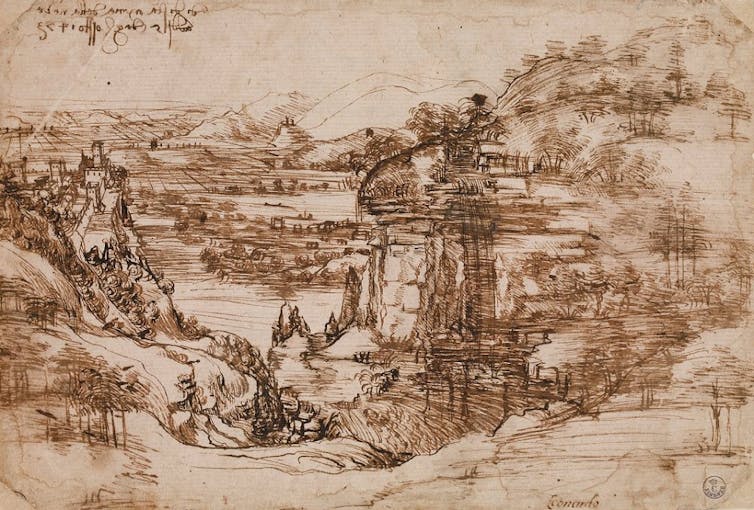
He was non, however, just fascinated by water's artistic features. He wanted to sympathise the fluid dynamics of water: the eddies and vortices under and on water surfaces. Equally a polymath, he was able to combine his knowledge and ability in art, design, scientific discipline, philosophy and engineering to design projects, ideas and instruments to test his hypotheses.
In a compilation of writings – the Codex Leicester (1510) – Leonardo made 730 conclusions nearly water alone. Through this work and others, da Vinci made many contributions to modern water engineering and science including accurately describing the hydrological wheel, understanding the affect of catamenia speed on pressure level, and engineering canals and reservoirs for overflowing management and irrigation.
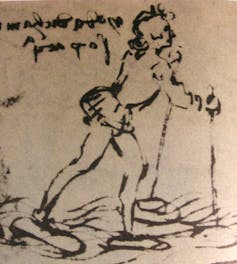
Not all of his long listing of water ideas and creations were every bit influential or as accurate, such as his water walking device, but collectively, his uniqueness and overriding contribution to water scientific discipline and engineering is the evolution of a scientific arroyo. He is arguably the first hydrologist who formulated hypotheses on the basis of empirical bear witness.
The ramifications of his rigour live on today in a much wider sphere. As h2o is the vehicle of nature, Leonardo da Vinci is the driving force behind the foundations of h2o scientific discipline and engineering.
Visual illusions – Dr Alessandro Soranzo
Leonardo da Vinci pioneered the written report of physiognomy past introducing the concepts of "moti mentali" contained in the Codex Urbinae, written between 1452 and 1519 and printed by Raffaelo du Fresne every bit Trattato della Pittura in 1651. Moti mentali can be translated as the representation of transient, dynamic mental states, thoughts and emotions. For da Vinci, the goal of portraitists should be representing the inner thoughts of their sitters, non just the external advent.
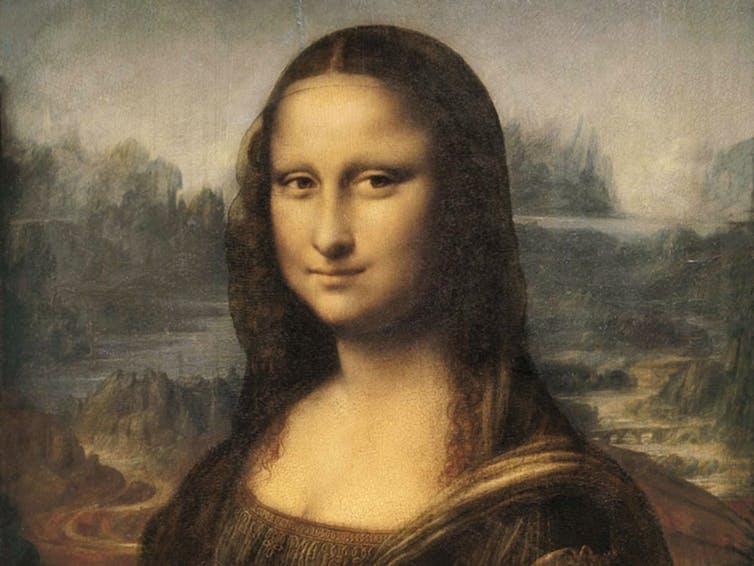
For this reason, Leonardo created "ambiguous" facial expression. In cryptic expressions at that place is a abiding "change: of appearance, hence dynamicity. Leonardo developed the technique of "sfumato" (from the Italian word for vanishing like smoke) for this purpose. In sfumato, the transitions from bright to dark, or from one color to another, are subtle to soften or obscure sharp edges.
This technique was non invented by Leonardo, but he further adult it and his utilize is unique. I concur with Alexander Nagel'southward idea that Leonardo'due south use of sfumato is dissimilar from whatever other painter/s – including from that of Andrea del Verrocchio, who was Leonardo'southward teacher.
In detail, in many of Leonardo's portraits, it is almost incommunicable to say when one colour ends and another starts – and this is axiomatic in some crucial parts of his paintings, such equally the mouths of his sitters. For example, the Laboratoire du Centre de Recherche et de Restauration des Musées de France, in collaboration with the European Synchrotron Radiations Facility, reported that Leonardo used upwards to 30 layers of varnish to achieve the subtle shading effectually the oral fissure of the La Bella Principessa (a portrait attributed to Leonardo past Martin Kemp as recently equally 2011). Each of these layers was one-half the thickness of a human being pilus. The expanse around the mouth of the Mona Lisa has a similar level of particular.
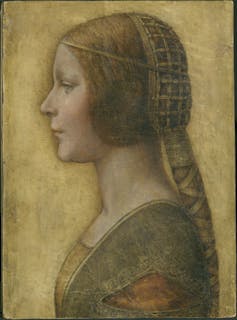
My colleague, Michelle Newberry, and I suggested in 2015 that Leonardo created a sort of illusion effectually the mouth area in some of his portraits (for example, Mona Lisa and Bella Principessa) – from some vantage points, the sitters look content and cheerful just at other times they announced pensive or melancholic.
Information technology is remarkable that Leonardo, creating visual illusions, played with the disagreement between the optics and the brain centuries before scientists understood the mechanisms behind it.
Taking each field of study separately, there have undoubtedly been improve artists, more important engineers or greater mathematicians. But as an individual, da Vinci was unprecedented and remains without peer – in art or scientific discipline.
Source: https://theconversation.com/four-ways-in-which-leonardo-da-vinci-was-ahead-of-his-time-115338
0 Response to "Does Lenardo Da Vinci Was Making Political Statement in His Art?"
Post a Comment